


“Every man has his chance. If he cannot be President he can, at least, be prosperous. In this respect, America is not only the exception to the general rule, but the social wonder of the world."
Frederick Douglass 1818 - 1895; American social reformer, from his renowned lecture ‘Self-Made Men’
TWO AND A HALF CENTURIES OF GOING AHEAD AND GETTING AHEAD
On July 4, 2026, America celebrates the 250th anniversary of the Declaration of Independence - its semi-quincentennial - a historic milestone that invites not only reflection on the nation's past, but also appreciation for the institutions, ideals, and achievements that have enabled it to endure and adapt across two and a half centuries. It is a journey that began with a declaration and grew into the world’s most influential economy. But that journey didn't come together overnight, and it certainly didn't come together by accident. It emerged from a war that left the new nation with limited resources, fragile institutions, and an uncertain future.
Indeed, in 1789, the nation's credit was non-existent, its currency was worthless, and the federal government lacked the power to collect significant revenue. Few would have forecast that within a century the U.S. would become the world's largest economy and leading manufacturing nation - few, perhaps, except for Alexander Hamilton, the founding father who most profoundly influenced the economic development of this country. George Washington, our first president under the Constitution, appointed Hamilton as Secretary of the Treasury shortly after Congress created that department in 1789, putting him in charge of the nation's economy.
Having worked in the import/export business on the island of St. Croix in the British West Indies as a young man, Hamilton supplemented that practical experience with a deep understanding of financial concepts gained through relentless self-study. The result was a unique vision of the nation's economic potential. He wasted little time putting that vision into practice: one of his first acts as Treasury Secretary was to have the federal government assume all the individual war debts of the 13 states and roll them into one ‘National Debt.’
By consolidating the states' debts, the new government established its financial credibility and began to attract foreign investment that fueled new industries and infrastructure projects. Hamilton understood that for a nation to be truly independent, it first has to be solvent. The national debt itself became a symbol of the young republic's commitment to meeting its obligations.
His other major act as Treasury Secretary was to create a national bank, which could lend the federal government money, hold its savings, create a national currency, and provide credit to business and industry. The establishment of the First Bank of the United States, chartered in Philadelphia in February 1791, helped to stabilize the nation's finances, transforming U.S. debt from near-worthless paper into creditworthy securities and lowering interest rates for both public and private borrowers.
The Bank had limited powers compared with modern central banks, but it assisted the Government in its financial transactions and served as a depository for public funds. It was established as a private institution under a 20-year charter, with a capital stock of $10 million - an unprecedented sum that made it not only the largest financial institution but also the largest corporation of any type in the new nation. To put its scale in perspective, the federal government's entire revenue in 1791 totaled just $4.4 million, meaning the Bank's capitalization was more than twice the size of the U.S. government's annual income. Some 20 percent of the stock was owned by the federal government, with the remainder sold to private citizens to raise funds for the bank. But because a full share was expensive, investors could first purchase a cheaper certificate called a ‘scrip,’ which guaranteed the right to buy a full share in installments: part in gold or silver and the rest in government bonds.
Excitement over this new investment opportunity spread quickly, and the public offering sold out in less than an hour, setting off frenzied speculation in bank shares. The price of scrips - and that of Treasury securities (government bonds sold to raise federal funds) - quickly doubled in the secondary market before spiking even higher, fueling America's first asset bubble. But just as rapidly as prices had run up in July, they came crashing down a month later, revealing the fragile nature of unregulated markets, where speculation could quickly give way to economic collapse. Under Hamilton's leadership, the government stepped in with significant purchases of public debt to bolster market confidence and prevent a full-blown financial catastrophe. It was, in effect, the nation's first financial bailout - and it worked.
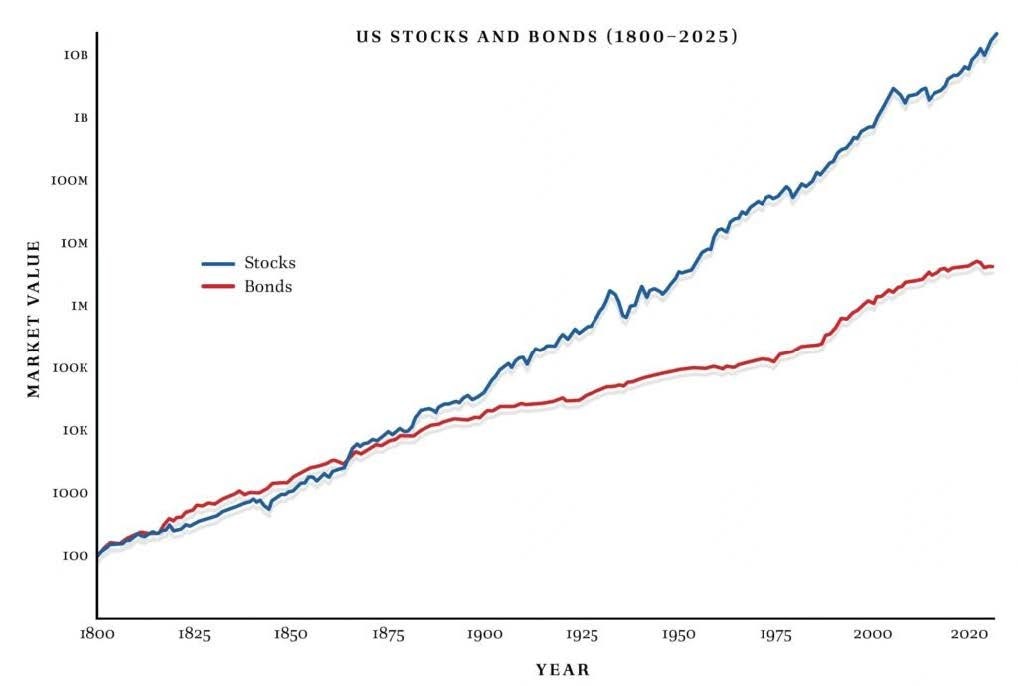
Past performance is not indicative of future results.
The episode became known as the Bank Scrip Bubble of 1791. Within weeks of the bank's first share issuance, the young nation had experienced its first stock market bubble and crash. Although the 1791 bubble was short-lived, another crisis was already brewing. The early months of the following year were marked by a speculative mania fueled by rampant credit expansion within the banking industry. As speculation ran ahead of economic reality, the foundations that had supported market growth began to give way, laying the groundwork for what would become known as the Panic of 1792. The unfolding disaster was a harsh warning about the perils of lax lending and speculative excess...
JULY 2026
TWO AND A HALF CENTURIES OF GOING AHEAD AND GETTING AHEAD.pdf