


Economic & Market Summary Q1 2026
____________________________________________________________________
Market Summary March 31, 2026
___________________________________________________________________________________________
 Stock Market
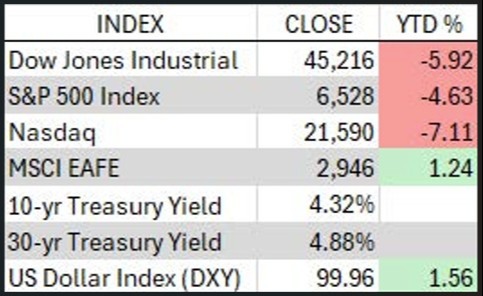
During the first quarter of 2026, volatility returned to the markets because of higher than expected inflation readings, tighter financial conditions, fear of Artificial Intelligence (AI) disruption on corporate profits, and the consequences of war with Iran. As a result, the S&P 500 index endured one of its worst quarters since 2022, trading negative 11 of the 13 weeks, while the S&P 500 volatility index (VIX) was up almost 60% since the beginning of the year reflecting investors’ growing concern with the unsettled investment landscape.
Performance returns for the main equity indices were varied for the quarter. The S&P 500 equal weight index (RSP) actually rose slightly, 0.63%. while the S&P 500 market cap index was down 4.6%. Both the Dow Jones Industrial Average and the technology concentrated Nasdaq composite briefly entered correction territory (a market decline of more than 10%) during the quarter, and were down 5.92% and 7.1% respectively, to start the year. Stock leadership has shifted sharply in 2026. Notably, the Roundhill Magnificent Seven ETF led the sell-off, falling 11.3% for the year, reflecting investors’ concern of peak earnings growth, high valuations and increased obstacles that have clouded the near-term investment prospects.
S&P 500 earnings estimates for the first quarter and full year 2026 are still projected to show robust growth of 13% and 17%, respectively. Interestingly, since the war started on February 28th, earnings estimates have increased by 3.6%, with every sector seeing a rise. Despite analyst optimism, investors have repriced risk assets given the elevated uncertainty of the duration of the conflict and the impact it could have on corporate profits.
International markets maintained their outperformance of U.S. markets in the first quarter of 2026. Although the MSCI EAFE, which tracks developed global stock markets, entered correction territory during the quarter, it finished up, 1.24%. Emerging markets continued to outperform developed market peers, led by markets such as Korea and Taiwan, benefiting from AI-related expenditures.
_______________________________________________________________________________________________________________
 Bond Market & Interest Rates
Since the last Federal Reserve interest rate cut in December of 2025, the FOMC maintained the federal funds rate at 3.5%-3.75% after both meetings in 2026. The combination of stubbornly sticky inflation data, and the geopolitical risk in the Middle East pushing oil prices higher and constraining the global supply chain, has arguably caused the Fed to turn more hawkish in how they view the trajectory of future interest rates.
Inflation expectations as seen from Treasury Inflation Projected Securities in March suggested the markets were pricing in 3%+ inflation for both 2026 and 2027. Therefore, forecasts for rate cuts this year have faded, raising concerns that rates will remain higher. The 10-year Treasury yield, which started the year at 4.11% increased to 4.32%.
Performance returns in the fixed income markets have been fairly stable despite the recent volatility. The Bloomberg U.S. Aggregate Index return was down, 0.05% in the 1st quarter, while the U.S. High Yield Index return was slightly worse, down 0.50%.
Credit spreads, which measure the difference in yield between corporate and government bonds, widened during the quarter. Starting the year near historical lows these spreads widened over concerns of the economic impact of inflation, and over slowly eroding credit quality of private and public debt. Investors are now demanding higher yields to compensate for higher perceived risk.
_______________________________________________________________________________________________________________
 Economic Landscape
GDP: The U.S. economy grew modestly in the fourth quarter of 2025, as the U.S. Real Gross Domestic Product (GDP) increased by 0.7% annualized and 2.1% for the full year. The main contributor to the cooled growth in the quarter was the decrease of Federal government spending and investment, due to the shutdown. The Federal Reserve now projects another solid real GDP growth of 2.4% for 2026 suggesting continued productivity from AI and technology investment.
Inflation: The Core Personal Consumption Expenditures (PCE) Price Index, which excludes volatile food and energy costs rose 3.1% year-over-year in January, the highest reading in 2 years, reflecting price pressures concentrated on such things as healthcare, housing and utilities. The Core PCE, continues to remain elevated above the Fed’s targeted 2 percent level.
Labor Market: The U.S. unemployment rate in March was 4.3%, maintaining its recent low readings. While the latest reports reflect healthcare strikes, and ongoing effects of trade and immigration policies, the trend continues to convey a weak hiring and a slow firing environment. Job displacement continues to be a growing concern as AI increasingly threatens a wide range of workers, particularly those in white-collar roles and recent college graduates.
ISM Manufacturing: The Institute for Supply Management (ISM) Manufacturing Index or PMI, which measures the direction and health of the manufacturing economy, was 52.7 in March. This is the third straight month of expansion since 2022, due to new orders and production, despite continued manufacturing workforce reductions and uncertain demand.
__________________________________________________________________________________________________________
 Commodities
Oil: After slumping 20% last year, WTI crude oil gained a staggering 74% during the first quarter of 2026, due to the conflict with Iran and the ensuing supply shock.
Precious metals: Gold and silver have melted down after the outbreak of war with Iran. In March, gold bullion dropped by 13% while silver fell by over 20%, Despite the current month’s turbulence, gold and silver were up for the quarter, 8.6% and 2.1% respectively.
Precious metals: Gold and silver have melted down after the outbreak of war with Iran. In March, gold bullion dropped by 13% while silver fell by over 20%, Despite the current month’s turbulence, gold and silver were up for the quarter, 8.6% and 2.1% respectively.
March 2026
Economic & Market Summary Q1 2026.pdf